
Edge Welded Vacuum Bellows
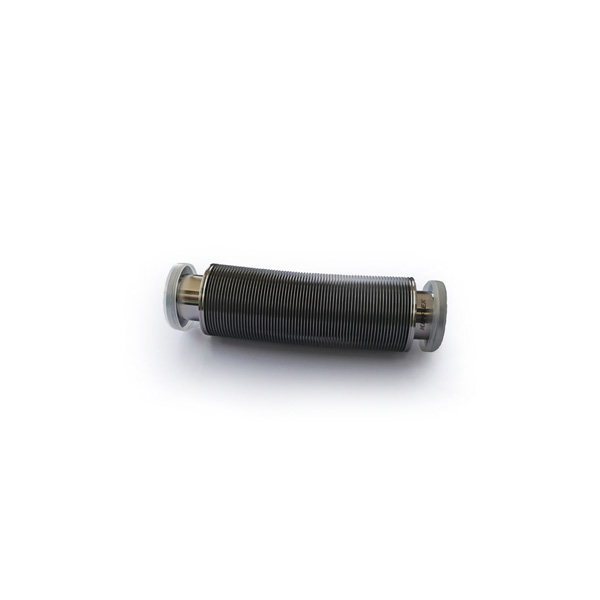
Edge Welded Vacuum Bellows
Edge welded vacuum bellows are metal bellows specially designed for use in vacuum environments. Edge welded vacuum bellows achieve vacuum sealing by assembling vacuum flanges or vacuum fittings at both ends of the welded bellows. Edge welded bellows are formed by stacking many corrugated metal diaphragms. A significant amount of precise welding work is required to form the welded bellows. Edge welded vacuum bellows offer superior stroke capability and a very low spring rate, providing exceptional flexibility and precise control for many applications. Ultra-High Vacuum (UHV) is one typical application for edge welded bellows. The ends of the edge welded vacuum bellows are connected to standard vacuum flanges, ensuring excellent compatibility. Common vacuum flanges include KF flanges, ISO flanges, and CF flanges. A variety of non-standard vacuum components can be manufactured according to specific requirements. We perform a helium leak test on every edge welded vacuum bellows to ensure they are suitable for demanding vacuum conditions. We guarantee that the helium leak rate of every bellows is less than 1×10⁻⁹ mbar·l/s (or 1×10⁻¹⁰ mbar·l/s), meeting Ultra-High Vacuum (UHV) requirements.
- Material: Stainless Steel, Inconel, Titanium, Monel, Hastelloy
- Size: 6.8mm to 700mm outside diameter
- Typical lead time: 15 days
- MOQ: 1 PC
*Custom bellows are available on request.

edge welded vacuum bellows types
In comparison to formed vacuum bellows, edge welded vacuum bellows require a significantly longer production time. Accordingly, the production cost of edge welded vacuum bellows is much higher. However, the performance advantages of edge welded vacuum bellows are irreplaceable. You can select the correct one according to your engineering needs. If you are confused about your choice, please do not hesitate to contact our engineering team.
Frequently Asked Questions
Longer stroke. Compared to formed bellows of the same length, they offer a significantly larger range of motion.
Stainless steel 316L is the standard. For high-performance requirements, AM350 or Inconel are also used.